




Passive vs Active RFID Tags: Core Differences & When to Use Each
Whether you're tracking factory equipment, counting retail inventory, locating hospital assets, or reading utility meters in the field, every RFID project comes down to two main tag types: passive RFID tags and active RFID tags. Many companies pick the wrong type during pilots — either the tags cost too much and require constant battery maintenance, or the read range is too short and real-time performance falls short of business requirements.
The most fundamental difference between the two is whether the tag has its own power source. The power supply method directly determines read range, per-unit cost, maintenance intensity, data collection timeliness, and applicable scenarios. This article provides a side-by-side comparison table and a structured decision framework to help plant managers, warehouse supervisors, store managers, QC inspectors, biomedical engineers, and field inspectors quickly decide which type to use.
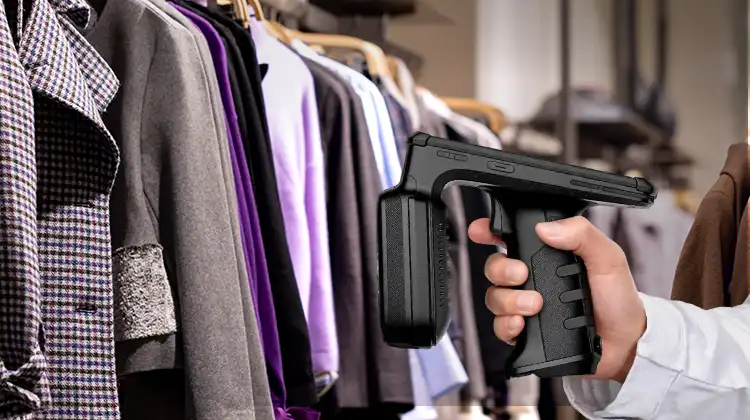
1. What Is a Passive RFID Tag?
A passive RFID tag has no internal battery. When it enters the radio frequency field emitted by an RFID reader, the tag's antenna harvests electromagnetic energy to power the chip. Once activated, the chip transmits its encoded data back to the reader via backscatter. Because it "feeds off the reader's energy," the tag itself is low-cost, small in size, and virtually maintenance-free.
Common frequency bands and characteristics:
Low Frequency (LF, 125–134 kHz): Read range is typically a few centimeters to tens of centimeters. Better penetration through liquids and metal interference. Suitable for animal identification, access control, and some industrial tool tracking.
High Frequency (HF, 13.56 MHz): Read range is generally 0–1 meter. Representative technologies include ISO 15693, ISO 14443, and NFC. Suitable for library books, pharmaceutical blister packs, membership cards, and medical device tracking.
Ultra-High Frequency (UHF, 860–960 MHz): Typical standard includes EPC Gen2 / ISO 18000-63. Conventional paper-based tags achieve a range of several meters to over ten meters; with high-power antennas, ranges of 10–15 meters are possible. Best suited for retail, warehousing, apparel, pallets, and case-level batch inventory.
Advantages: Extremely low per-unit cost (bulk UHF inlays can be as cheap as a few cents to a few dollars), no battery, long lifespan (typically 10+ years unless physically damaged), ideal for massive item-level tagging.
Disadvantages: Read range depends on reader power, antenna design, and metal/liquid interference. Does not support continuous autonomous broadcasting. For continuous temperature logging, battery assistance or external sensors are often required.
Typical applications: Electronic article surveillance and inventory counting in apparel stores, case/pallet tracking in supermarkets and e-commerce warehouses, lot-level drug tracking in pharma, hospital linen and low-value consumable tracking, WIP workstation binding on factory floors, library and archive management.
2. What Is an Active RFID Tag?
An active RFID tag has a built-in battery and can actively transmit signals without relying on the reader's field for power. There are two common operating modes: beacon mode (continuous or periodic broadcasting) and triggered response mode (the tag responds only when polled by a reader or gateway). Because it has its own power source, transmission power is higher, and communication range far exceeds that of passive tags.
Common frequency bands and characteristics:
433 MHz: Good penetration, long range. Commonly used for containers, yards, and vehicle-level assets. Referenced in ISO 18000-7.
2.4 GHz / BLE / UWB: Suitable for indoor real-time locating systems (RTLS), personnel and equipment tracking. UWB offers higher precision but requires greater infrastructure investment.
Read range: Typically 30–100 meters; open yards can reach several hundred meters. When paired with a positioning engine, active tags support real-time location, geofencing, and movement tracking.
Advantages: Long range, strong real-time capability, can embed temperature/humidity/vibration/light/GPS sensors, better adaptability in obstructed environments, ideal for high-value assets and large moving targets.
Disadvantages: Higher per-unit cost (typically tens to hundreds of dollars), larger size, requires battery replacement or recycling, more complex system software and positioning infrastructure, significantly higher total cost of ownership compared to passive solutions.
Typical applications: Factory cranes, tow trucks, and movable equipment; containers and vehicles in logistics parks; cold chain temperature-sensing tags; RTLS for ventilators, infusion pumps, and mobile MRI machines in hospitals; outdoor meter boxes and manhole covers for utilities; government field enforcement vehicles and equipment.
3. Passive vs Active: Side-by-Side Comparison
The following table compares passive and active RFID tags across the same dimensions for easy reference during selection meetings.
| Dimension | Passive RFID Tag | Active RFID Tag |
| Power Source | No battery; powered by reader RF field | Built-in battery; self-powered communication |
| Communication Mechanism | Backscatter returns ID | Active beacon or triggered response |
| Read Range | LF < 0.5m; HF 0–1m; UHF 1–15m | 433MHz/2.4GHz: 30–100m+; open yards up to hundreds of meters |
| Per-Unit Cost | Very low (UHF inlay: cents to a few dollars) | High (tens to hundreds of dollars; more with sensors) |
| Real-Time Capability | Read only when passing a reader; suitable for periodic inventory | Second/minute-level continuous reporting; suitable for RTLS |
| Sensor Capability | Rarely built-in (semi-passive can add external sensors) | Can embed temperature, humidity, positioning, vibration, GPS, etc. |
| Environmental Adaptability | Needs anti-metal tags or frequency adjustment near metal/liquid | More stable in open, obstructed, or outdoor environments |
| Standards & Ecosystem | EPC Gen2 v2, ISO 18000-63, 15693, 14443 | ISO 18000-7/4, proprietary RTLS, BLE, UWB |
| Scale Suitability | Millions of items, cases, pallets, garments, books | Thousands/tens of thousands of high-value, long-range, real-time assets |
4. When to Use Passive vs Active: A Simple Decision Framework
Follow these six steps — distance, real-time, cost, asset value, environment, and sensors — to make a more reliable choice than simply looking at budget.
4.1 Prioritize Passive RFID Tags When:
Mass item-level tagging: Apparel, supermarket FMCG, e-commerce warehouse cases, pharmaceutical boxes, library books, archives.
Read range is within a dozen meters: Inbound/outbound portals, store inventory guns, production line workstations, fixed pallet read points.
Cost-sensitive, low per-unit price required: Target tag cost of a few dollars or less, with millions of tags applied annually.
Periodic inventory rather than continuous tracking: Daily/weekly cycle counts are sufficient; no need for second-by-second location.
Controlled environment: Dry warehouse where UHF works well. If metal/liquid is present, use anti-metal hard tags or switch to HF.
Only identity ID needed: Lot number, serial number, SKU, work order — no need for continuous temperature/humidity data.
Example: A national apparel retailer uses UHF passive RFID tags for receiving, inventory, and loss prevention across all stores. A factory warehouse applies UHF tags to raw material cases and uses forklift-mounted antennas for batch reads. A hospital linen room uses HF/UHF passive tags to track in/out flows — all cutting manual inventory time by more than half.
4.2 Prioritize Active RFID Tags When:
Long-range identification: Yards, ports, power plant compounds, logistics parks require coverage from tens to hundreds of meters.
Real-time location / theft prevention: Hospital high-value asset RTLS, prison/court/construction site personnel tracking, government patrol vehicles, 3PL cross-dock operations.
High-value mobile assets: Cranes, tow trucks, containers, generators, ventilators, IT cabinets, weapons/evidence.
Continuous sensing required: Cold chain temperature/humidity, vaccine transport, precision instrument vibration, outdoor meter status.
Heavily obstructed or predominantly outdoor environments: Active 433 MHz / 2.4 GHz is more stable than UHF passive.
Tag volume is manageable, per-asset value is high: Willing to spend tens to hundreds of dollars per tag in exchange for visibility and reduced loss.
Example: A gas company installs active RFID tags with temperature/humidity/leak sensors on outdoor regulator stations and valve wells, with patrol gateways collecting data periodically. A supermarket cold chain uses active temperature tags to monitor refrigerated trucks. A large hospital deploys 2.4 GHz RTLS to locate ventilators, reducing idle equipment.
4.3 Middle Ground: Semi-Passive / Battery-Assisted Passive (BAP) Tags
If you need low-cost backscatter communication but also want to record temperature data, consider battery-assisted passive (BAP) tags. The tag still uses backscatter for communication but has a small battery to power the chip and sensors. Suitable for pharmaceutical cold chain, food transport, and laboratory samples — the full temperature curve is read out during scanning, without continuous broadcasting like fully active tags.
5. Quick Industry Reference Table
| Industry | Recommended Tag Type |
| Factory / Production Line | Passive UHF for WIP, cases, small parts; Active RTLS for cranes, molds, mobile tools, hazardous material carts; |
| Retail / Apparel / Supermarket | Passive UHF for store-wide and warehouse operations; Active temperature tags for multi-zone cold cabinets needing continuous monitoring; |
| 3PL / E-commerce Warehouse | Passive UHF for receiving to outbound; Active tags for yard vehicles and cross-border containers; |
| Hospital / Pharmacy | Passive HF/UHF for drug boxes and consumables; Active RTLS for ventilators, wheelchairs, infusion pumps; |
| Water / Gas / Electric / Municipal | Passive for indoor meters read manually or with handhelds; Active for outdoor dispersed meters needing auto-reporting, tamper detection, and location; |
| Government / Law Enforcement / Field | Passive for documents and samples; Active + BLE/433 MHz for patrol vehicles, enforcement gear, temporary seals; |
Choosing RFID is not about "active is more advanced." It's about whether your business truly needs long range and real-time capability. If your goal is to reduce the labor cost of massive inventory counting, passive RFID tags are usually more cost-effective. If your goal is to know the real-time location, status, and environmental parameters of high-value assets, active RFID tags are worth the investment.
Start with a small-scale proof of concept: use passive tags to validate inbound/inventory workflows, and active tags to test yard/equipment positioning. Then calculate the three-year total cost of ownership based on read rate, miss rate, battery replacement cost, and software integration cost — this is far more reliable than comparing tag prices alone.
If you are evaluating RFID for a factory, store, warehouse, or hospital, feel free to contact SEUIC. We can provide a tag frequency, reader placement, and pilot metric checklist tailored to your business.
Related News
-

Workshop Windows Tablet: Bringing Legacy Desktop Apps to the Production Line
Product Updates | 2026.11.09Learn More
-
Rugged Tablet Buying Guide: Practical Selection for Industrial & Field Use
Product Updates | 2026.11.09Learn More
-

Non-Stop Inventory: AUTOID Q9 Pro Dynamic Warehouse Counting Solution
Product Updates | 2026.11.09Learn More
-

RFID Medical Asset Tracking: Instant Location Solution for Infusion Pumps & Monitors
Product Updates | 2026.11.09Learn More