




2026 Portable UHF RFID Reader Selection Guide
A quick wave of a handheld device, and hundreds of items are logged in three seconds — this isn't science fiction. It's the real transformation brought by portable UHF RFID readers. Yet faced with a dizzying array of specs and brands, buyers often find themselves lost: How much read range is enough? What bulk read speed qualifies? How do you match the right device to your scenario? This guide starts with the fundamentals, walks through six key selection parameters, covers five major application scenarios, and compares three leading vendors in a table — helping you make a confident decision.
1. What Is a Portable UHF RFID Reader?
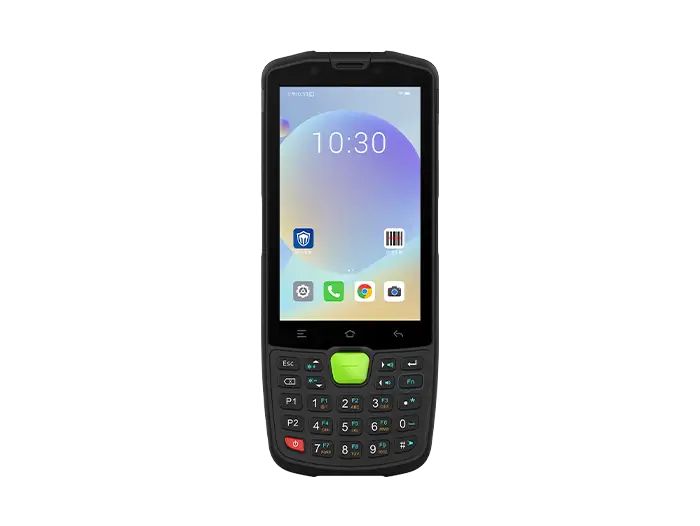
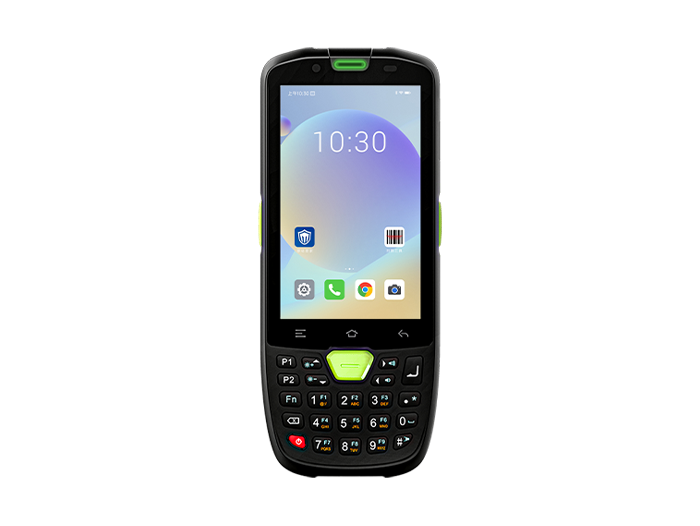
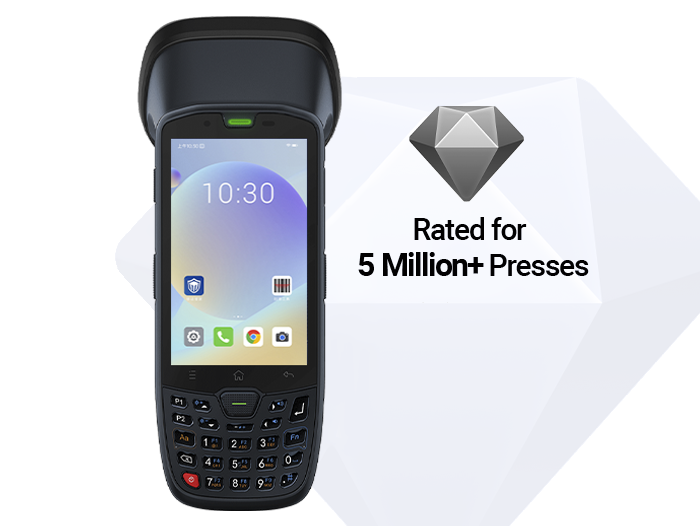
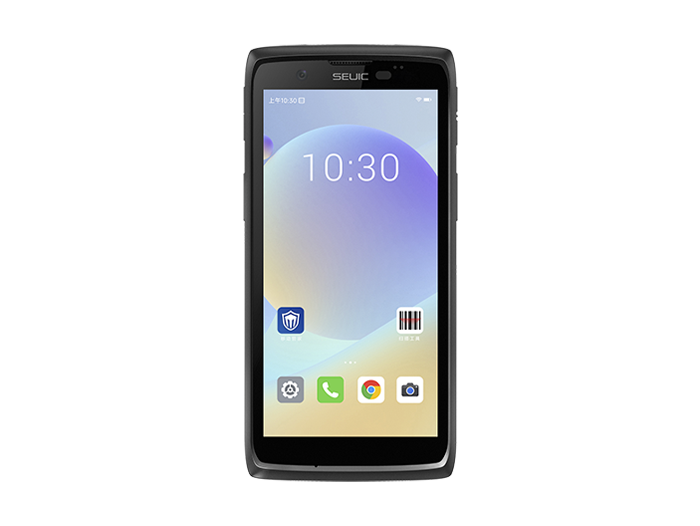
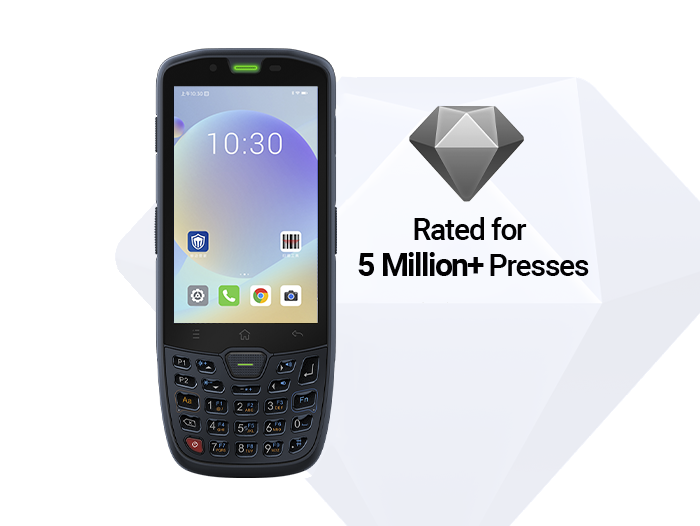
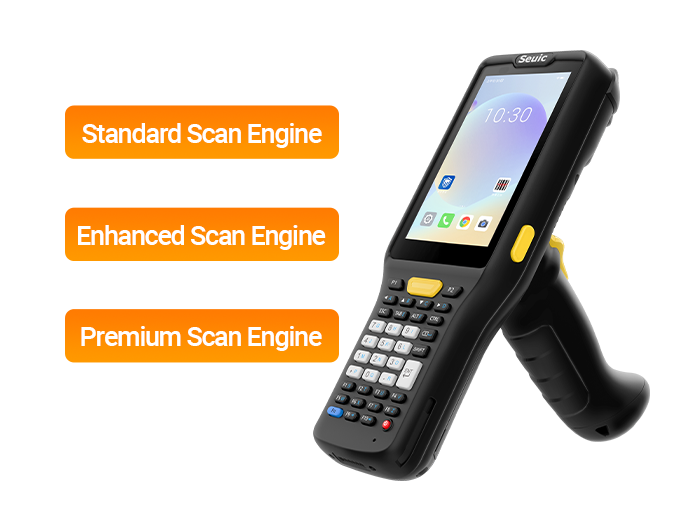
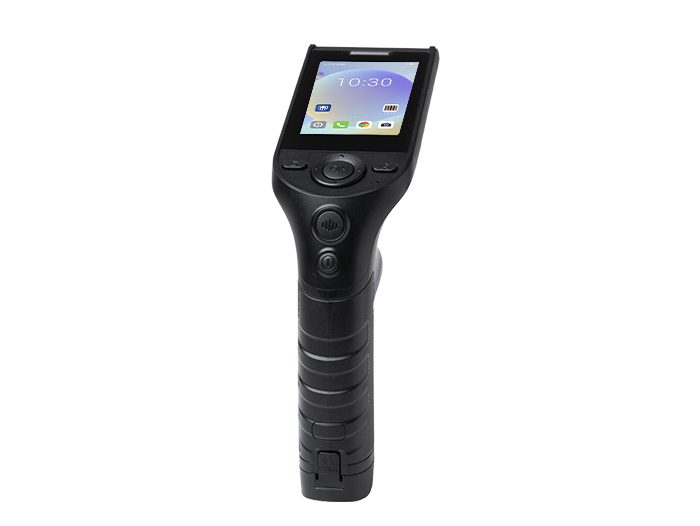
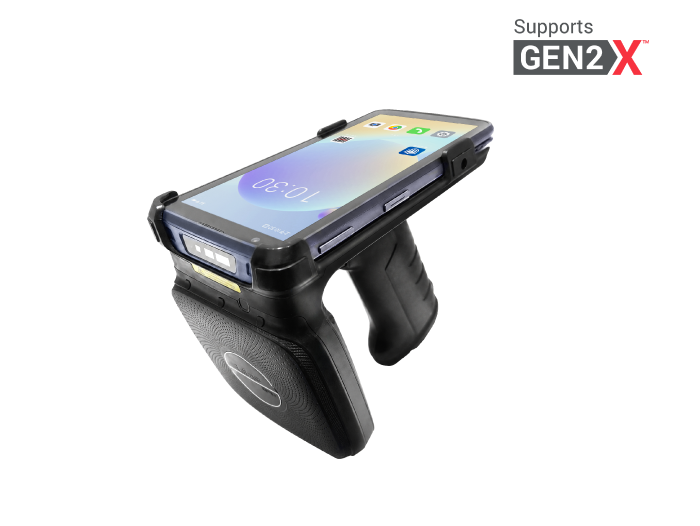
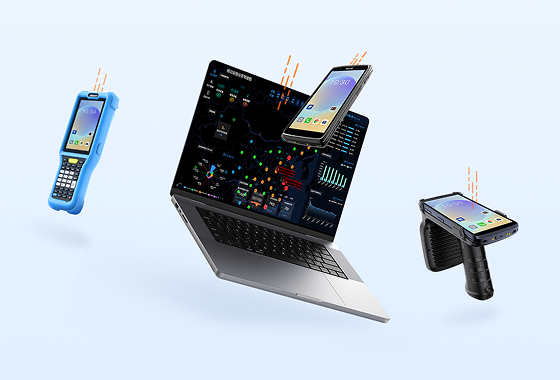
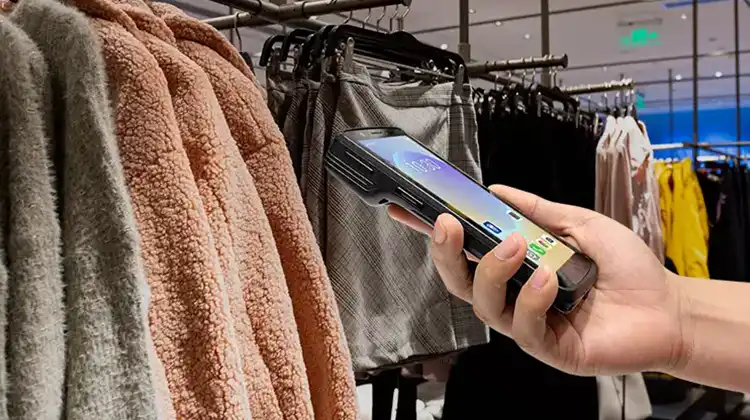
A portable UHF RFID reader — also called a handheld UHF RFID reader — is a mobile data collection terminal operating in the 860–960 MHz ultra-high frequency band, capable of batch reading and writing RFID tags. It integrates a UHF RFID module, barcode scanner, Wi-Fi/Bluetooth, Android operating system, and a high-capacity battery into a single handheld device. This allows workers to perform mobile RFID data collection anywhere — warehouse aisles, retail floors, production lines, hospital wards, outdoor utility pits, and more.
Over the past decade, with the global adoption of the EPC Gen2 (ISO 18000-6C) protocol and the cost of RAIN RFID tags dropping to pennies per unit, handheld UHF RFID readers have evolved from "specialized equipment" into "everyday tools." For plant managers, warehouse supervisors, retail operators, hospital nursing directors, and utility meter readers, the traditional "scan one item at a time" barcode model is being replaced by the "wave and read hundreds at once" RFID approach — boosting inventory efficiency by 10–20x and reducing human error rates to below 0.1%.
But in practice, buyers commonly face three pain points:
Specs that don't translate: Read range, bulk read speed, polarization, protocol compatibility — a mountain of terms, with no way to tell which ones actually matter.
Wrong scenario matching: Using a retail-grade device in a factory with metal environments — nothing reads. Using an industrial long-range model in a pharmacy — bulky and wasteful.
Too many vendors to choose from: Numerous domestic and international brands, overlapping product matrices, and wildly varying quotes.
This guide starts with six selection dimensions, matches them to five typical application scenarios, and concludes with a table comparing the product matrices of three major vendors — giving you a practical evaluation framework you can put to work.
2. How It Works: The Core Principle of "Reading Tags Wirelessly" at 860–960 MHz
The core technology behind portable UHF RFID readers is far-field backscatter:
The reader transmits 860–960 MHz electromagnetic waves via its antenna (specific frequency varies by regional compliance: China 920–925 MHz, USA 902–928 MHz, Europe 865–868 MHz).
When a tag enters the electromagnetic field, it modulates its EPC code and sends it back via backscatter.
The reader demodulates the signal and completes identification.
The entire interaction is governed by two international standards:
EPC Global Gen2 (ISO 18000-6C): The air interface protocol universally supported by current portable UHF readers.
ISO 18000-6B: Still in use by some legacy systems. For new purchases, 6C compatibility is recommended.
Beyond the RFID module, modern handheld UHF RFID readers typically also integrate:
Barcode scan engine (1D/2D, including damaged and screen code recognition)
NFC near-field communication
Android smart operating system
Wi-Fi 6 / Bluetooth 5.x / Cellular 5G multi-connectivity
SDK for integration with WMS, ERP, MES, and other backend systems
3. Six Core Selection Parameters: What to Verify Before You Buy
3.1 Read Range
Short range (0–3m): Ideal for retail shelves, pharmacy counters, and medical record management.
Medium range (6–15m): Suitable for warehouse aisle inventory and logistics sorting.
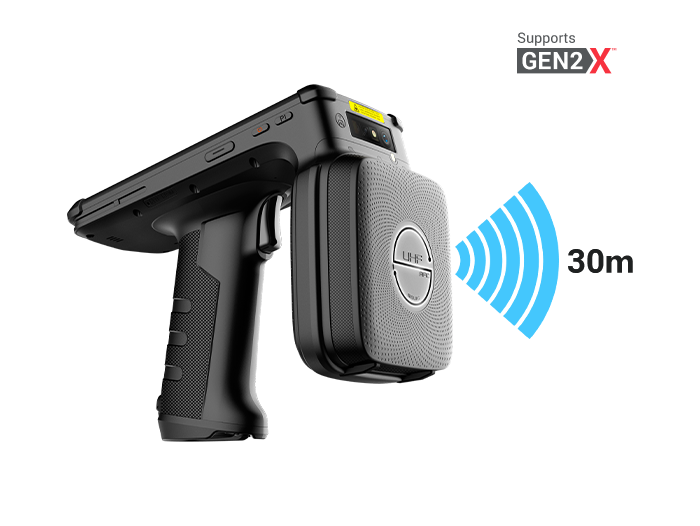
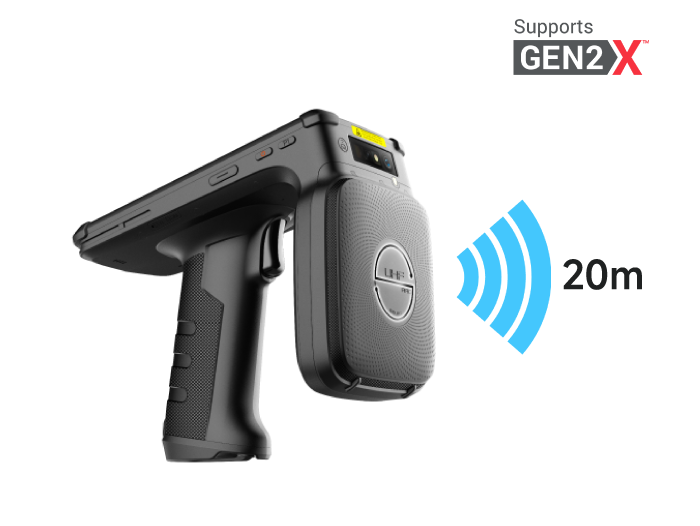
Long range (20m+): Best for outdoor assets, utility meter boxes, and large high-rack warehouses.
3.2 Bulk Read Speed (Tags per Second)
Measured in tags/second. For high-density inventory scenarios:
| Level | Speed |
| Entry-level | 50–200 tags/sec |
| Advanced | 1,000+ tags/sec |
| High-performance | 1,300+ tags/sec |
3.3 Ingress Protection and Drop Resistance
| Rating | Suitable Environment |
| IP65 + 1.5m drop | Semi-industrial, retail, healthcare |
| IP67 + 1.8m drop | Transportation, entertainment, healthcare, retail |
| IP67 + 2m drop | Heavy industry, outdoor, cold chain |
3.4 Battery Life
| Usage Intensity | Capacity |
| Light use | 3,200–5,000 mAh |
| All-day operation | 7,000–9,000 mAh |
| Heavy industrial | 11,000 mAh+ with swappable battery |
Removable battery design is preferred for seamless shift transitions.
3.5 Connectivity and Communication
Wireless: Wi-Fi 6, Bluetooth 5.x, NFC, 5G/4G cellular
Wired: USB Type-C, Pogo Pin
Recommendation: For industrial environments, prioritize Wi-Fi 6 + Bluetooth 5.0 to ensure stable coverage across large warehouse areas without packet loss.
3.6 SDK and System Integration
Quality vendors provide:
l Android SDK and demo APK
l Standard APIs (RFID read/write, barcode, NFC)
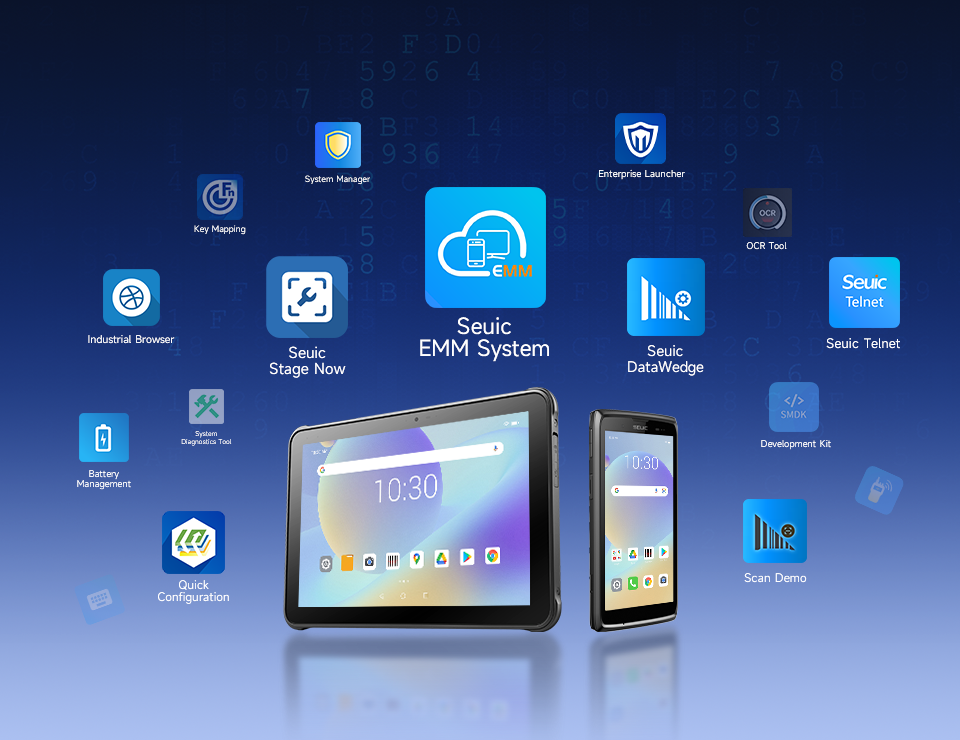
l MDM/MAM/MCM enterprise management platform
l Free POC and technical support
4. Five Industry Application Scenarios
4.1 Warehousing & Logistics / 3PL
Pain Point: Large warehouses with tens of thousands of SKUs — monthly inventory is time-consuming and labor-intensive.
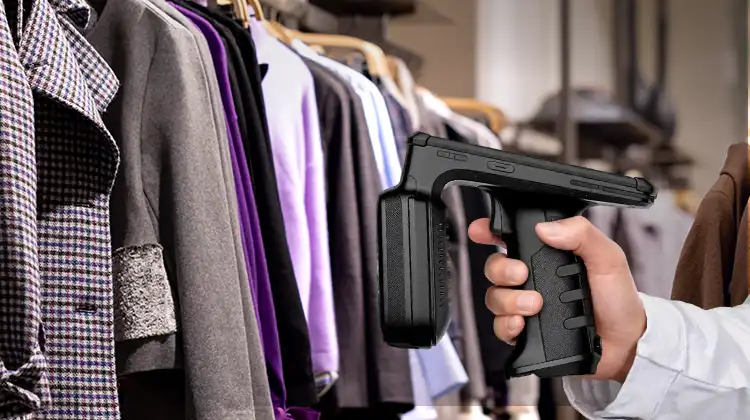
Recommended Configuration: Read range 15m+, bulk read speed 1,000+ tags/sec, IP67, battery 7,000 mAh+.
Pain Point: Store shelf inventory, anti-counterfeiting traceability, self-checkout.
Recommended Configuration: Read range 0–6m, lightweight (<600g), IP67, supports NFC + barcode.
4.3 Healthcare & Pharmaceuticals
Pain Point: Medical records, drugs, and equipment tracking — requires precision with zero missed reads.
Recommended Configuration: Short-range high-precision (0–3m), IP67, supports HF/NFC dual-band.
4.4 Manufacturing & WIP Management
Pain Point: Production line workstations, metal environments, false read prevention.
Recommended Configuration: Long range 20m+, anti-metal interference algorithm, 2m drop resistance, IP67.
4.5 Public Utilities & Outdoor Inspection
Pain Point: Power meter boxes, water pipe pits, gas valves — outdoor wide-temperature operation.
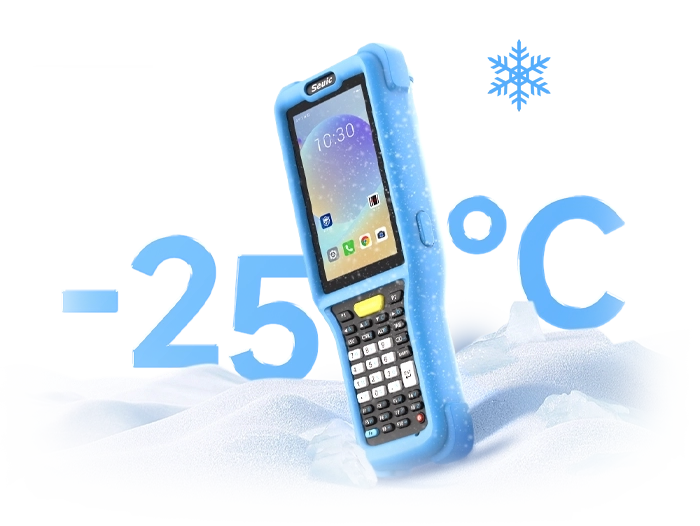
Recommended Configuration: -20°C to +60°C wide temperature range, IP67, long-range reading, swappable battery.
5. Vendor Comparison: Product Matrix Overview
The table below compares three representative vendors and their flagship products across six dimensions: vendor, representative product, read range, bulk read speed, protection rating, and core positioning.
| Vendor | Representative Product | Read Range | Bulk Read Speed | Protection Rating | Core Positioning |
| Zebra Technologies | TC22R / RFD90 Sled | TC22R: ~24m; RFD90: long-range | 1,300+ tags/sec | IP65 / industrial grade | Global brand with complete product line, ideal for multinational enterprises |
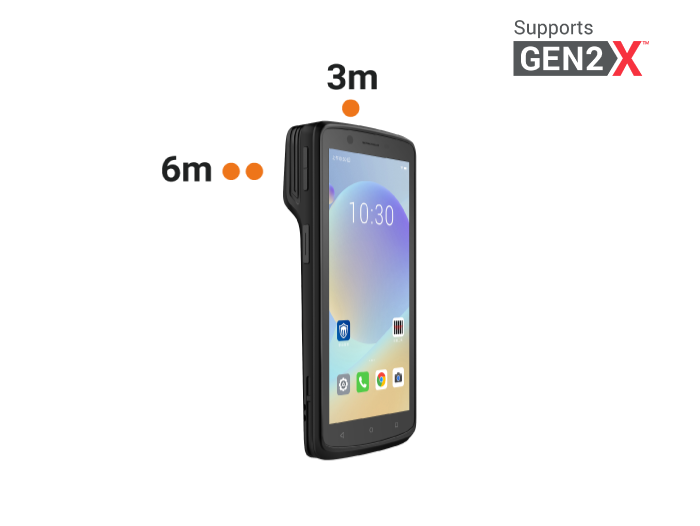
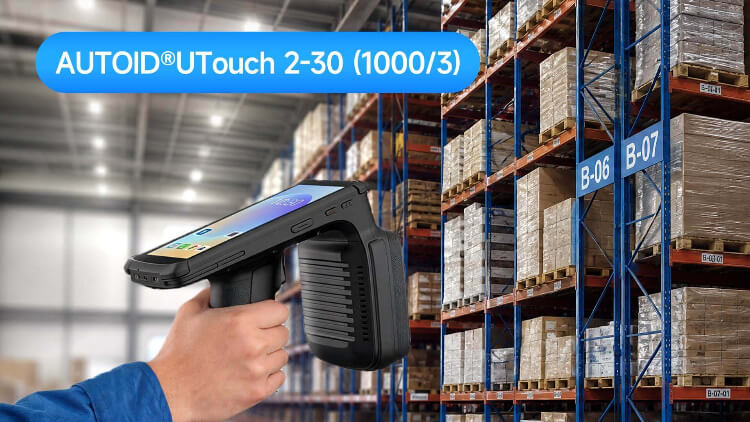
| Seuic | AUTOID UTouch 2-30 / AUTOID UTouch 2-S6+3 | UTouch 2-30: 30m+; UTouch 2-S6+3: vertical 0–3m / horizontal 0–6m dual-range | UTouch 2-30: 1,000+ tags/sec; UTouch 2-S6+3: high-precision | IP67 (both models, 1.8–2m drop) | Domestic industrial flagship — balances ultra-long-range high-density with dual-range precision; includes EMM integrated platform |
| UROVO | DT51U 5G / DT50P / DT50D / RFG91 Handle | DT51U / DT50P: 20m+; DT50D: 1.5m; RFG91: 15m+ | DT51U: 1,000+ tags/sec; RFG91: 1,300+ tags/sec | IP67 (most models) | Rich product line with strong cost-performance ratio, covering light-use to long-range |
Selection Recommendations:
Need ultra-long range (30m+) and industrial high-density reading → Seuic AUTOID UTouch 2-30
Need precise short-range + flexible dual-range switching → Seuic AUTOID UTouch 2-S6+3
Value brand reputation and global service → Zebra TC22R or RFD90
Prioritize cost-performance and product variety → UROVO DT51U 5G or DT50D
6. Decision Checklist: 5 Steps to Lock In Your Device
Measure the distance: On-site test your actual needs at 1.5m / 6m / 15m / 30m, then match to the corresponding range class.
Verify the protocol: Confirm full compatibility with EPC Gen2 / ISO 18000-6C.
Check protection: For industrial environments, IP67 + 1.8m+ drop resistance is mandatory.
Calculate battery life: Derive required capacity from shift length × bulk read intensity. Prioritize swappable batteries.
Validate integration: Require the vendor to provide SDK + POC testing + enterprise management platform demo.
Portable UHF RFID readers are no longer a question of "whether to adopt," but "which model fits." Warehousing & logistics demand long range and high density. Retail and healthcare prioritize lightweight precision. Manufacturing and outdoor environments require industrial durability. Apply the six parameter dimensions from this guide to your own scenario checklist, validate with on-site POC testing, and you'll avoid costly procurement pitfalls.
Founded in 2002, SEUIC Technologies Co., Ltd. is committed to mastering core technologies, continuously improving innovation capabilities, and delivering outstanding branded products including mobile computers, RFID readers, tablets, barcode scanners, and fixed readers. With highly reliable products and efficient service, our solutions are widely applied across manufacturing, retail, logistics, healthcare, and more. We provide frontline workers with more durable real-time data collection tools, helping you improve operational efficiency and take productivity to new heights.
Related News
-
2D Barcode Scanner Buying Guide: Decoding, Environment & Lifecycle
Product Updates | 2026.10.10Learn More
-
What Is a 2D Barcode Scanner? Definition, How It Works & Supported Symbologies
Product Updates | 2026.10.09Learn More
-

How to Choose a Rugged Android Tablet? Ditch Spec Stacking, Use Scenario Tables
Product Updates | 2026.10.09Learn More
-
What Is an RFID Tag? Structure, Working Principle & Common Uses
Product Updates | 2026.10.08Learn More