




Double Efficiency High-Bay Inventory: Normal vs Ultra-Long Range UHF RFID Handheld
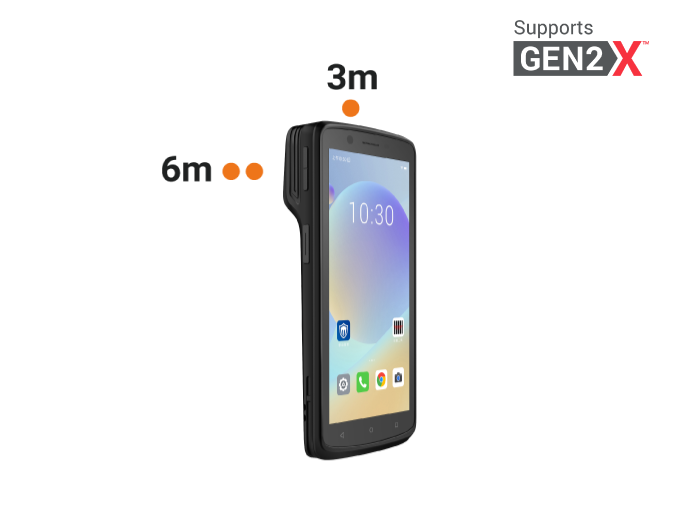
High-bay rack inventory is a classic pain point in retail warehousing RFID deployments. Standard UHF handheld readers typically achieve an effective read range of 3 to 5 meters. For racks over 6 meters tall, workers must use forklifts or aerial lifts to complete coverage — making single-rack inventory take over three times longer than ground-level scenarios. Ultra-long-range readers extend stable read distance to 20 to 30 meters. Combined with multi-polarization auto-recognition technology, they can read 1,000 tags in 3 seconds, enabling a new no-climb workflow for high-bay racks and dense storage environments. This guide breaks down the fundamental differences between the two device types across core technology, scenario suitability, and operational efficiency.
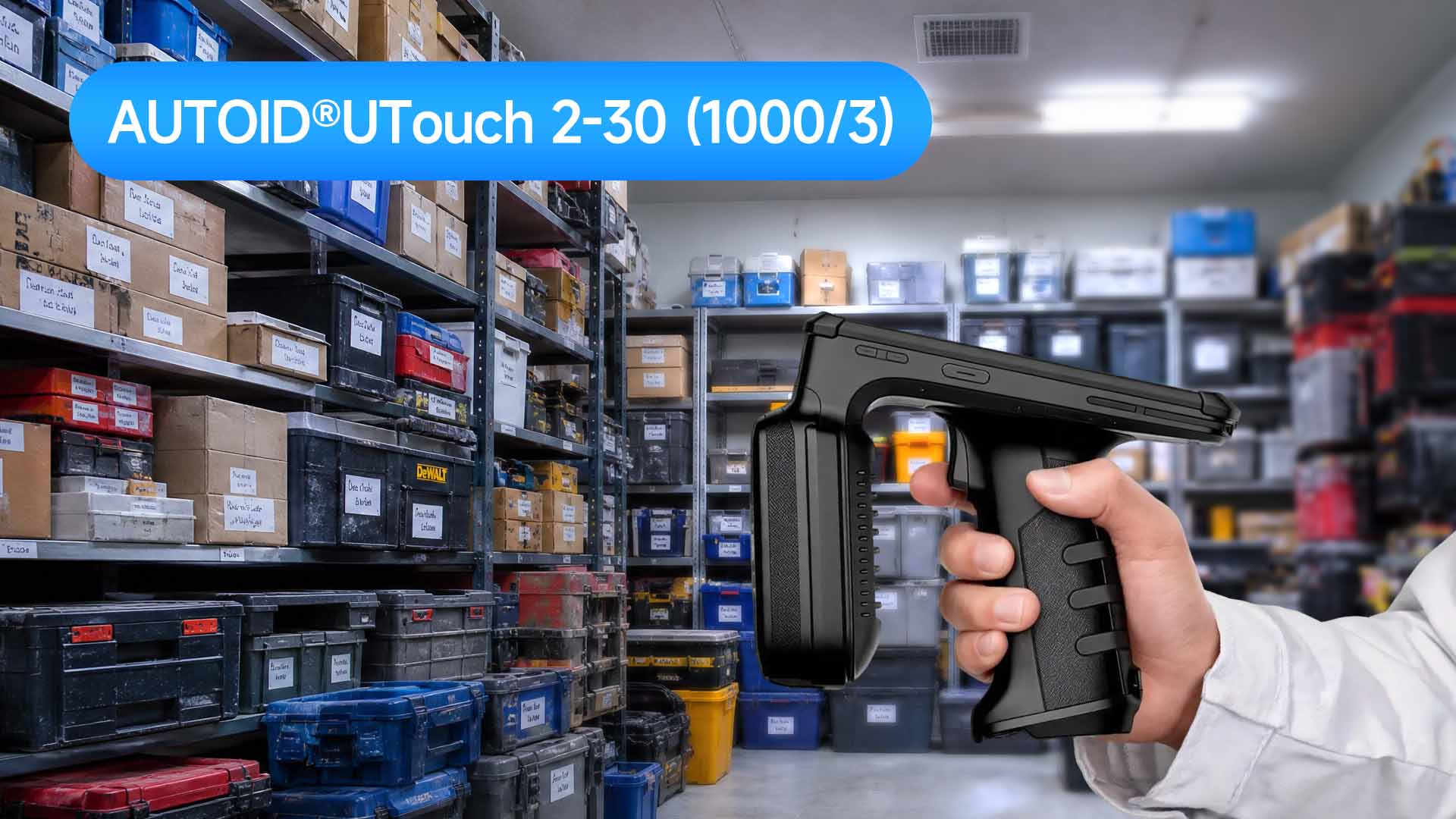
1. What Is a High-Bay Rack Scenario and What Special Requirements Does It Place on UHF Handheld Readers?
High-bay racks refer to automated or semi-automated rack systems with heights ranging from 6 to 15 meters. They are widely used in retail chain back-of-store warehouses, e-commerce forward fulfillment centers, and third-party logistics hubs.
High-bay racks impose special requirements on UHF handheld readers across three dimensions:
Read distance must cover the full rack height. A 6-meter rack requires an effective read distance of at least 6 meters.
Dense tag processing capability. A single layer on a high-bay rack typically holds 30 to 50 cartons — 2 to 3 times the tag density of ground-level floor stacks.
Interference resistance. Metal rack uprights, pallet metal frames, and liquid beverage packaging all cause signal attenuation and tag collisions.
Standard UHF handheld readers fall short precisely on these three dimensions when applied to high-bay rack scenarios.
2. What Are the Core Technical Differences Between Standard and Ultra-Long-Range UHF Handheld Readers?
The core differences span five dimensions — read distance, antenna polarization technology, bulk read speed, missed read rate, and interference resistance — which directly determine their suitability for high-bay rack environments.
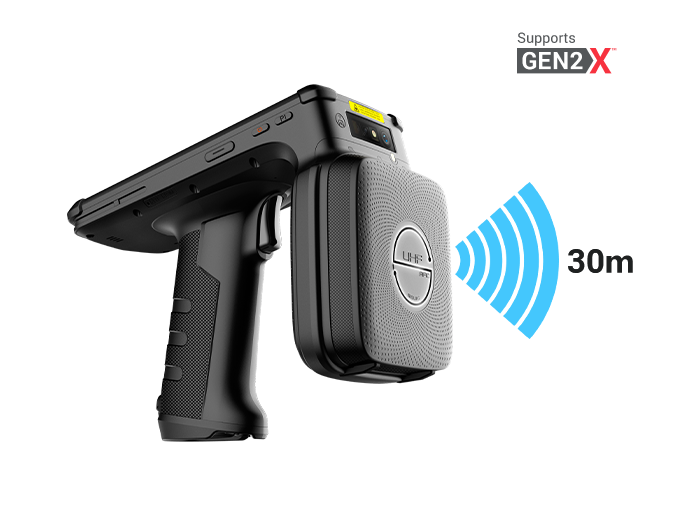
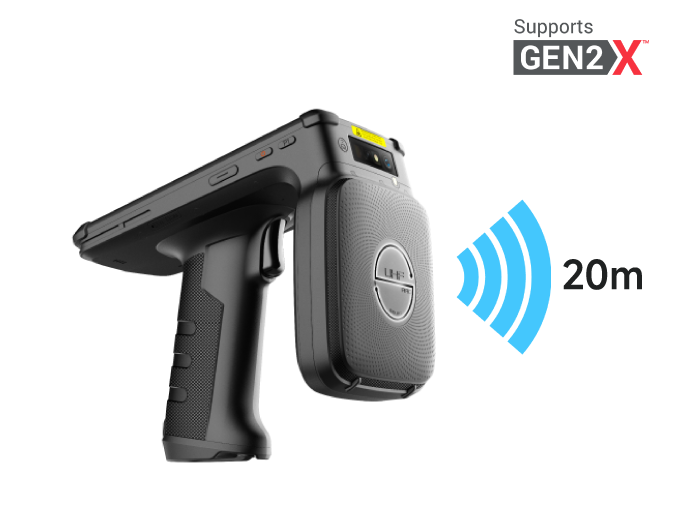
Stable read distance. Standard UHF handheld readers achieve a stable read distance of 3 to 5 meters. Ultra-long-range UHF handheld readers (represented by the SEUIC AUTOID UTouch 2-30 (1000/3) RFID handheld reader) reach 20 to 30 meters — a gap of over 5x.
Antenna polarization. Standard UHF handheld readers use a single circularly polarized antenna. Ultra-long-range models feature multi-polarization auto-recognition technology, integrating omnidirectional, vertical, and horizontal polarization modes.
Bulk read speed. Standard UHF handheld readers take 12 to 18 seconds to read 1,000 tags. Ultra-long-range models complete the task in under 3 seconds.
Missed read rate in dense tags. Standard UHF handheld readers have a missed read rate of 6% to 12%. Ultra-long-range models keep it below 1%.
Recognition rate in liquid interference scenarios. Standard UHF handheld readers achieve 73%. Ultra-long-range models reach 96%.
It is worth noting that standard UHF handheld readers may advertise a nominal read range of 10 to 15 meters. However, this is a theoretical value measured in open-air lab conditions. In actual warehouse environments, interference from metal racking and surrounding equipment typically reduces effective range by 60% or more. Ultra-long-range model specifications, by contrast, are stable values measured in simulated high-bay rack environments.
3. How Much Actual Efficiency Difference Do the Two Device Types Deliver in High-Bay Rack Scenarios?
The efficiency difference is reflected in three quantifiable indicators: whether climbing is required, time per rack inventory, and daily rack coverage.
A test warehouse with 42 sets of 8-meter-high racks originally used a standard-brand UHF handheld reader. Workers needed forklift assistance for elevated access. Average time per rack set was 14 minutes, with 8 sets completed per day and an inventory accuracy rate of 91.7%. After switching to an ultra-long-range model, workers could cover the full rack height from ground level without any lifting equipment. Average time per rack set dropped to 2.5 minutes, daily coverage increased to 38 sets, and inventory accuracy rose to 99.6%. The elimination of climbing contributed approximately 40% of the efficiency gain, with the remaining 60% coming from improvements in bulk read speed and missed read rate.
The bottleneck in high-bay rack inventory has never been device read speed — it has always been "can the worker reach it?" Extending read distance from 5 meters to over 25 meters fundamentally transforms the workflow from "must climb" to "scan from the ground."
4. How Does the Ultra-Long-Range Model Specifically Address the Three Core Pain Points of High-Bay Racks?
The three core pain points of high-bay rack inventory are: insufficient read distance requiring climbing, dense stacking causing missed reads, and liquid/metal interference causing signal attenuation. The technical design of ultra-long-range models addresses all three with targeted optimizations.
First, 30-meter stable read distance completely eliminates the need for climbing. Standard UHF handheld readers are limited by RF power and antenna gain, typically achieving 3 to 5 meters of effective read range. Ultra-long-range models optimize the RF front-end circuit and boost antenna gain, extending stable read distance to 20 to 30 meters. Workers standing on the ground can cover racks 8 to 10 meters high without forklifts, aerial lifts, or other auxiliary equipment. This saves equipment rental and operator labor costs while eliminating safety hazards associated with working at height.
Second, multi-polarization auto-recognition technology solves the dense tag missed read problem. Traditional circularly polarized antennas can only identify tags whose orientation matches the antenna's polarization direction. Since tags on racks are attached at random angles, missed read rates reach 6% to 12%. The multi-polarization auto-recognition technology in ultra-long-range models integrates omnidirectional, vertical, and horizontal polarization modes. During the reading process, the device intelligently senses tag angles and dynamically switches to the optimal polarization scheme.
Third, bulk read speed optimization counters liquid and metal interference. Liquid packaging such as beverages and household chemicals absorbs UHF signals, while metal pallets reflect signals and cause collisions. Ultra-long-range models employ an anti-collision algorithm optimized for high-density scenarios. Combined with the speed advantage of reading 1,000 tags in under 3 seconds, recognition rates remain stable above 96% even in liquid interference environments.
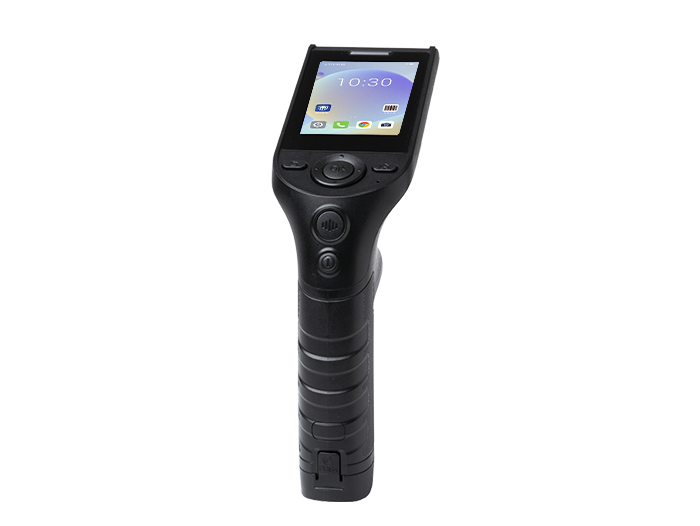
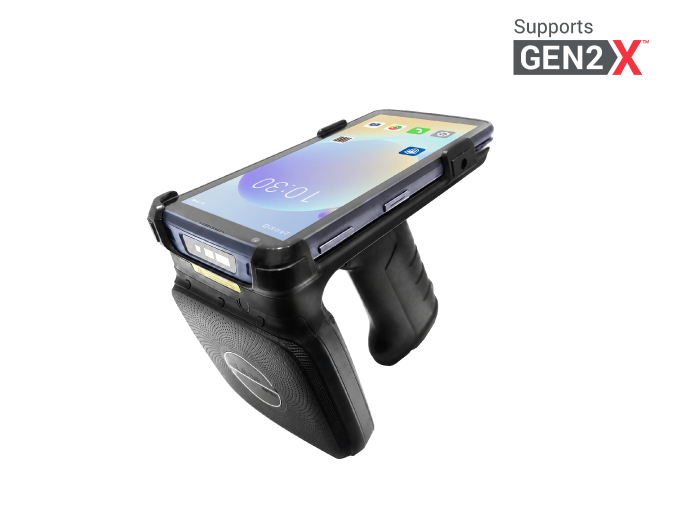
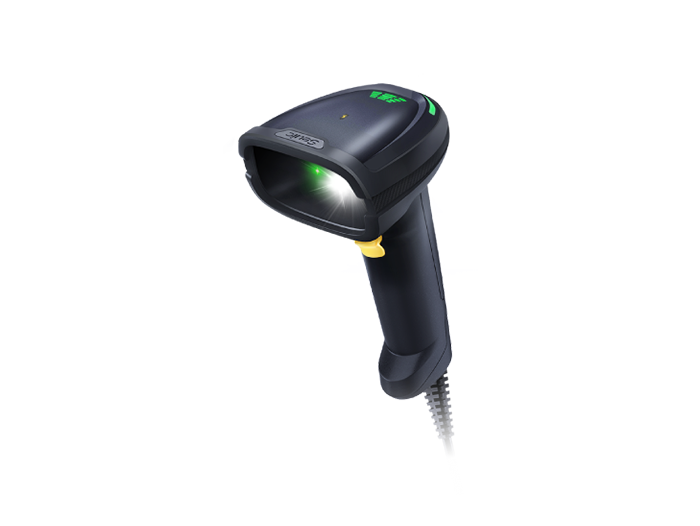
The SEUIC AUTOID UTouch 2-30 (1000/3) UHF RFID handheld reader is a representative product in this ultra-long-range category. With IP67 protection and an 11,700mAh high-capacity battery supporting 24 hours of continuous operation, it is suitable for high-bay racks, dense storage, and fresh food warehousing.
5. What Parameters Should You Focus On When Selecting an Ultra-Long-Range UHF Handheld Reader?
Focus on five core parameters to avoid being misled by nominal specifications.
5.1 Stable Read Distance, Not Theoretical Read Distance
Theoretical values are typically measured in open-air lab conditions. In actual warehouse environments, interference from metal, liquids, and personnel reduces effective range by 50% to 70%. Always request measured data from the supplier in a simulated high-bay rack environment.
5.2 Bulk Read Speed and Missed Read Rate
A single layer on a high-bay rack typically holds 30 to 50 tags, and the total tag count for a full rack can exceed 200. Bulk read speed directly impacts inventory efficiency. Batch read time for 1,000 tags should be under 5 seconds, and the missed read rate should be below 2%.
5.3 Antenna Polarization Method
Single circularly polarized antennas suffer from high missed read rates in dense, multi-angle tag attachment scenarios. Choose models that support multi-polarization auto-recognition.
5.4 Battery Life
High-bay rack scenarios often require 4 to 6 hours of continuous concentrated inventory work. Battery capacity should be at least 10,000mAh, with actual runtime no less than 16 hours.
5.5 Protection Rating and Durability
Warehouse environments expose devices to bumps, dust, and liquid splashes. Protection rating should be at least IP65, and drop height should be no less than 1.2 meters.
6. Frequently Asked Questions (FAQ)
Q1: Can I use a standard UHF handheld reader for high-bay rack inventory?
Yes, but efficiency will be very low. Standard UHF handheld readers have an effective read range of 3 to 5 meters. For racks over 6 meters, forklifts or aerial lifts are required. Single-rack inventory takes 5 to 6 times longer than with an ultra-long-range model, and missed read rates typically range from 6% to 12%. Standard readers are suitable for small warehouses with rack heights under 5 meters and low inventory frequency, but not as a long-term solution for high-bay racks.
Q2: Is longer read distance always better for ultra-long-range UHF handheld readers?
Not necessarily. Excessive read distance can cause the signal to pick up tags from adjacent rack positions, especially in dense storage environments. The goal is not "as far as possible" but "far enough without false reads."
Q3: How is multi-polarization auto-recognition technology superior to traditional circular polarization?
Traditional circularly polarized antennas read tags at a fixed angle. When tags are oriented differently, missed reads occur at rates of 6% to 12%. Multi-polarization auto-recognition technology integrates omnidirectional, vertical, and horizontal polarization modes. The device senses tag angles in real time and dynamically switches polarization schemes. Recognition efficiency in dense tag scenarios improves by over 40% compared to traditional circular polarization, and recognition rates in liquid interference scenarios rise from 73% to 96%.
Q4: What high-bay rack scenarios is the SEUIC AUTOID UTouch 2-30 (1000/3) suitable for?
It is suitable for retail chain back-of-store warehouses, e-commerce forward fulfillment centers, third-party logistics hubs, dense beverage and household chemical pallet warehouses, and fresh food storage facilities with rack heights of 6 to 15 meters. The device supports the GEN2X protocol, reads 1,000 tags in 3 seconds, offers IP67 protection, and provides 24-hour battery life with an 11,700mAh battery.
Q5: Are ultra-long-range models significantly more expensive than standard models?
Currently, ultra-long-range UHF handheld readers cost approximately 30% to 50% more than comparable standard models. However, considering savings from eliminated aerial lift rentals, reduced labor costs, and improved inventory efficiency, the price difference is typically recovered within 6 to 12 months. Evaluate based on your specific circumstances.
From bustling retail stores and fast-paced logistics hubs to precision manufacturing workshops and rigorous healthcare facilities, SEUIC's digital data collection solutions have become deeply embedded in the operational fabric of countless industries. As a bridge connecting the physical world and digital systems, SEUIC not only provides durable hardware data collection devices but also resolves information asymmetry at the operational front line through comprehensive data capture and real-time analysis capabilities. No matter how industries evolve, SEUIC remains committed to unlocking the critical links of digital transformation, helping every enterprise achieve end-to-end transparent management — from the field to the decision-making level.
Related News
-
RFID Inventory for Beverages & Fresh Food: Handheld Reader Selection Guide
Product Updates | 2026.11.04Learn More
-

RFID Manufacturer Selection: China vs India Sourcing Decision Guide
Product Updates | 2026.11.04Learn More
-
Industrial RFID Company Selection: 5 Vendors Scenario Comparison Guide
Product Updates | 2026.11.04Learn More
-
RFID Asset Tracking: Non-Stop 20-Meter Remote Inventory for Retail Stores
Product Updates | 2026.11.04Learn More