





Industrial PDA Protection Rating Guide: IP67 & MIL-STD-810 Explained
Many factories, warehouses, and utility inspection teams see "IP67 industrial grade" or "military-grade drop resistant" on a spec sheet and place an order — only to find three months later that the device leaks after rain at the loading dock, the screen blacks out from condensation after coming out of cold storage, or the display shatters after a single drop near a forklift.
The problem isn't whether "IP" is listed. It's what standard the manufacturer tested to, under what conditions, and whether those conditions match your actual environment.
This guide is written for warehouse managers, production line supervisors, field inspectors, pharmacy inventory staff, and anyone who actually uses industrial PDAs. It breaks down protection ratings into a verifiable checklist.

1. How to Read IP Ratings: Don't Let the Numbers Fool You
IP codes are defined by IEC 60529 (Chinese equivalent GB 4208). The format is IP + first digit + second digit:
First digit: Dust ingress (0–6). 6 = completely dust-tight.
Second digit: Water ingress (0–9K). Each level only means "passed a specific water test" — they are not linearly cumulative.
Common three-tier differences:
| Rating | Dust | Water Test Conditions | What It Means (Not What You Assume) |
| IP65 | 6 — Fully dust-tight | 6.3 mm nozzle spray, ~12.5 L/min, all directions ≥3 min | Rainproof, washdown-resistant — cannot be submerged |
| IP67 | 6 — Fully dust-tight | Immersion in 1 m water for 30 minutes | Protects against heavy rain, puddles, falling into water — not long-term submersion |
| IP68 | 6 — Fully dust-tight | Depth + duration declared by manufacturer | You MUST check the bracketed "X meters / X hours" |
Three common misunderstandings:
IP67 is NOT an "upgrade" of IP65. They test different things. IP65 has not been tested for immersion. IP67 has not necessarily been tested for high-pressure spray.
IP68 has no universal depth standard. One device labeled IP68 might be rated for 1.5 m / 30 minutes, another for 10 m / 72 hours. If the conditions aren't specified, the rating is meaningless.
IP ratings do NOT cover: oil/corrosion resistance, drop protection, or cold storage condensation. They only answer one question: "Can dust and water enter the enclosure?"
Quick field rule of thumb: Loading docks → check spray protection. Outdoor patrol → check immersion. Water/wastewater or cleaning environments → check IP68 specifics. Cold storage → check condensation design first, then IP.
2. Drop Resistance & MIL-STD-810: Protection Beyond IP
IP covers water ingress. Drop resistance covers physical damage. Industrial PDAs often claim compliance with MIL-STD-810G/810H Method 516 — but this statement alone is highly misleading.
Five variables you must verify:
Drop height: Industrial handhelds typically specify 1.2 m / 1.5 m / 1.8 m. Consumer-grade phone cases often only test at 0.8 m.
Drop surface: Testing only the bottom face is not sufficient. Proper testing covers 6 faces + 8 corners + 12 edges.
Number of drops: MIL-STD-810G 516.6 commonly references 26 drops.
Surface material: Concrete is harsher than steel plate, which is harsher than plywood. "Plywood over concrete" is gentler than bare concrete.
Operational state: The device should be powered on during the drop, must not reboot afterward, and must retain all data — otherwise it's not field-ready.
Minimum benchmarks by industrial scenario:
Warehouse picking / retail inventory: ≥1.2 m
Production line, forklift area, construction site: 1.5 m onto concrete
Outdoor inspection, utility pole climbing, 3PL sorting: 1.5–1.8 m + tumble test
Don't trust "military-grade compliant." Ask: Which version of the standard? Which method? At what height? Onto concrete or plywood?
3. Selecting Protection Levels by Scenario
3.1 Indoor Warehouse / Retail Store / Pharmacy Inventory
Environment: No rain, minimal dust, occasional dirt
Recommendation: IP54–IP65
Drop: 1.2 m is sufficient
Key concerns: Wi-Fi roaming, scan engine read rate, gloved touch operation
3.2 Loading Dock / Transportation Sorting / Outdoor Logistics
Environment: Rain, water jet cleaning, cargo impacts
Recommendation: IP65 minimum; IP67 for outdoor use in rainy conditions
Drop: 1.5 m
3.3 Manufacturing Line / Automotive Parts / Metalworking
Environment: Dust, metal shavings, oil, floor washing
Recommendation: IP65 minimum; IP67 for wash-down floors
Additional considerations: Seal material, connector silicone gaskets, conformal coating on motherboard
Note: Oil ingress through IP65 seams is a real problem — this is not a waterproof rating failure
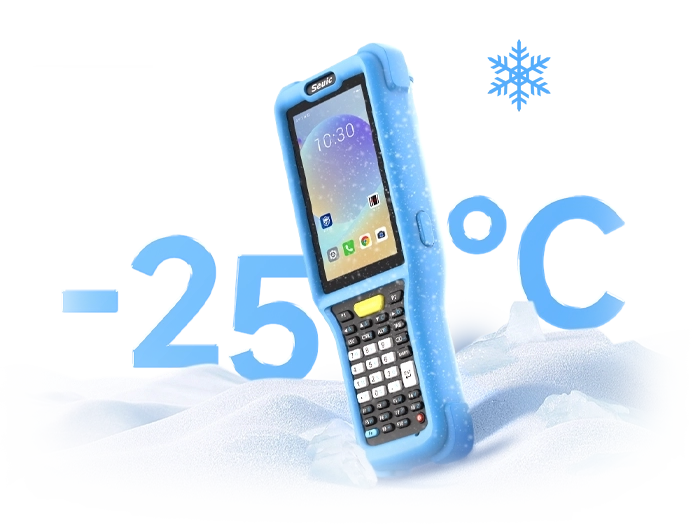
3.4 Cold Storage / Cold Chain Picking (-20°C or even -30°C)
IP is only the entry requirement. Anti-condensation is the real concern:
Operating temperature must be specified: -20°C or -30°C guaranteed startup
Low-temperature battery: an 8-hour rating at room temperature may drop to 3–4 hours in cold storage
Heated scan window: prevents frost from obscuring the barcode
Heated screen / hydrophobic coating: prevents condensation when moving between cold storage and ambient air
Conformal coating or drainage channels on the motherboard: protects against internal condensation
Critical distinction: IP67 only prevents external water from entering. It does not prevent condensation forming on the exterior and seeping through seams, nor internal condensation caused by temperature differentials. A cold storage PDA cannot be evaluated by IP rating alone.
3.5 Electric Power / Water Utility / Gas Inspection
Environment: Outdoor rain and snow, mud near manholes, occasional drops
Recommendation: IP67 + 1.5 m MIL-STD-810
Additional considerations: Glove mode, high-brightness display, NFC/RFID, offline data caching
3.6 Chemical Plants / Spray Painting / Flour Mills
Standard IP is insufficient. Explosion-proof certification is required.
Important: IP67/IP68 cannot replace explosion-proof (Ex) certification.
4. Acceptance Verification: How to Check if the Manufacturer Overstated Specs
Writing "IP67" on a spec sheet costs nothing. Perform these 4 checks before accepting delivery:
4.1 Demand a Third-Party Test Report — Not Marketing Images
Look for CNAS/ILAC accredited laboratory reports
The report must specify: reference standard (IEC 60529), full IP code, test water depth and duration
4.2 Distinguish Between "Designed to" and "Tested to"
"Designed to meet MIL-STD-810" ≠ actually tested
Only "Tested to MIL-STD-810H 516.8" counts as verified
4.3 For IP68, Always Ask for the Bracketed Conditions
At what depth? For how long?
If no specific values are stated, treat it as IP67
4.4 On-Site Sample Testing (Most Useful)
Spray test: Spray water at the screen, connectors, and battery cover for 1 minute, then open to check for moisture inside
Drop test: Drop from 1.2–1.5 m onto concrete (corners and faces, multiple drops). After dropping, verify scanning and data integrity
Cold storage test: Boot at low temperature → move to ambient → observe for screen blackout or touch drift
4.5 Inspect the Sealing Structure (Before Bulk Purchase)
A genuine industrial PDA will have:
Individual silicone gaskets for each port
Independent sealing strip for the battery compartment
Conformal coating on the motherboard
Waterproof breathable membranes for speaker and microphone openings
5. Summary: Higher Protection Is Not Always Better
The correct sequence for evaluating industrial PDA protection:
1. Define your scenario first (rain? dust? oil? drops? cold storage?)
2. Then choose the IP level (if IP65 is sufficient, don't force IP68 — you'll pay more in cost and thermal performance)
3. For drop resistance, verify height + number of faces/edges + concrete surface — don't rely on "military-grade" alone
4. For cold storage, prioritize anti-condensation design, low-temperature battery, and heated scan window
5. Before ordering, demand a third-party test report and physically drop-test a sample unit
An IP number is a threshold, not proof. It is scenario matching, transparent test conditions, and incoming inspection that determine whether a PDA is truly industrial-grade or just spec-sheet industrial-grade.
If you are drafting a technical evaluation matrix for a tender, consider making the following mandatory fields: "IP test conditions," "drop height / number of drops," "low-temperature operating temperature," and "anti-condensation design description." Score zero if any item is missing.
Before ordering, demand a third-party test report and physically drop-test a sample unit.
An IP number is a threshold, not proof. It is scenario matching, transparent test conditions, and incoming inspection that determine whether a PDA is truly industrial-grade or just spec-sheet industrial-grade.
Related News
-

2D Barcode Scanner Selection Guide for Warehouse: Receiving & Cycle Count
Product Updates | 2026.10.22Learn More
-
IWE Chennai 2026 Recap: Connecting Data to Smarter Operations
News & Events | 2026.10.22Learn More
-

Rugged Android Tablet vs PDA: Field Worker Selection Guide
Product Updates | 2026.10.21Learn More
-

Rugged Tablet OS Selection: Android vs Windows Comparison Guide
Product Updates | 2026.10.20Learn More